Back to School Maze Activity Book Kids: A Practical Guide to Building Skills Through Play
Every parent and educator knows the familiar back-to-school transition. After weeks of unstructured summer days, children often struggle to re-engage their focus, fine motor skills, and problem-solving abilities. The Back to School Maze Activity Book Kids offers a thoughtful, screen-free solution that turns this challenge into an opportunity for growth. This article explores what this activity book contains, how it addresses common developmental needs for children ages 4 to 6, and practical ways to use it for meaningful progress in preschool, kindergarten, and beyond.
What Is the Back to School Maze Activity Book Kids?
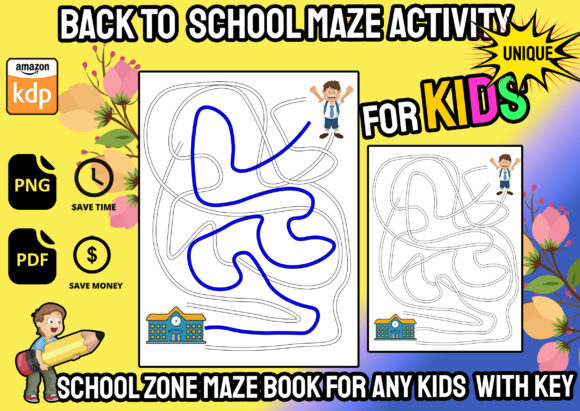
The Back to School Maze Activity Book Kids is a carefully designed resource that combines mazes, dot-to-dot tracing, and coloring activities in one package. It is not just a collection of puzzles—it is a structured tool aimed at children in preschool and kindergarten, specifically ages 4 to 6. The book includes 8 pages of beautifully illustrated activities, available as a PDF file with 8.5×11 inch bleed, along with 6 high-quality PNG images and an answer key. The illustrations are intentionally engaging, using back-to-school themes that help children feel excited and confident about the new school year.
This product stands out because it targets multiple developmental domains simultaneously. While children navigate mazes, they practice visual tracking and spatial reasoning. When they connect dots, they refine fine motor control and number or letter sequencing. And when they color, they express creativity while strengthening hand muscles needed for writing. The Back to School Maze Activity Book Kids is designed for easy printing at home or for use in digital formats, making it suitable for both individual use and classroom settings.
Understanding the Challenges Children Face at Ages 4 to 6
Children between the ages of 4 and 6 are at a critical stage of development. They are learning to hold a pencil, recognize patterns, follow instructions, and solve simple problems. Yet many face specific hurdles during the back-to-school period:
- Fine motor skill development: Many young children still struggle with the precise hand movements needed for writing, cutting, and drawing. Without regular practice, they may feel frustrated or avoid these tasks.
- Sustained attention: At this age, attention spans are naturally short. Sitting still for structured activities can be difficult, especially after a summer of free play.
- Transition anxiety: Starting or returning to school can cause nervousness. Children often need positive, familiar associations with learning tasks.
- Problem-solving confidence: Many children are still learning how to approach a problem step by step. They may give up quickly if they do not see immediate success.
- Letter and number familiarity: Preschool and kindergarten curricula expect children to recognize numbers and letters, but practice at home can feel like a chore.
The Back to School Maze Activity Book Kids directly addresses each of these challenges by blending fun with purposeful skill-building. Instead of drill-style worksheets, children encounter playful mazes that require them to think ahead, trace paths, and reach a goal. This structure naturally builds persistence and attention without pressure.
Fine Motor Skill Development Through Tracing and Coloring
The dot-to-dot tracing pages in the Back to School Maze Activity Book Kids are not just about connecting numbers. Each dot requires controlled pencil movement, which strengthens the small muscles in the hand and wrist. As children trace from one dot to the next, they practice the same motions used in letter formation. The coloring sections further reinforce grip strength and coordination, especially when children are encouraged to stay within the lines. Over time, these activities can reduce frustration during handwriting tasks at school.
Building Focus and Task Persistence
Mazes are natural attention-builders. When a child starts a maze in this activity book, they must hold the goal in mind while visually scanning the path. If they hit a dead end, they learn to backtrack and try another route—a valuable lesson in resilience. The back-to-school theme adds relevance: children may be navigating a maze to help a student find their classroom or to guide a pencil to the school bus. This narrative element keeps young learners engaged longer than abstract exercises. Practicing with the Back to School Maze Activity Book Kids even a few times per week can noticeably extend a child's ability to concentrate on a single task.
Easing Back-to-School Anxiety with Familiar Themes
The illustrations in this activity book feature school-related imagery: backpacks, desks, books, and friendly teachers. For children who feel nervous about the school environment, these images provide a safe, low-stakes way to engage with the concept of school. Parents can use the pages as conversation starters: "What do you think this child is carrying in their backpack?" or "Can you help the bus find its way to the school?" This social-emotional benefit is often overlooked in purely academic resources. The Back to School Maze Activity Book Kids becomes a bridge between home comfort and school readiness.
Strengthening Problem-Solving and Spatial Reasoning
Each maze requires the child to plan a route, evaluate options, and correct mistakes. These are foundational problem-solving skills that transfer directly to math, science, and reading comprehension. For example, a child who learns to visually scan a maze is also practicing the same skill needed to track words across a page while reading. The answer key included with the book allows parents or teachers to check work together, turning mistakes into learning conversations rather than failures.
At Home: Creating a Positive Morning or After-School Routine
Many parents use the Back to School Maze Activity Book Kids as a warm-up activity before school or as a calm-down task after school. Printing a single page each day gives children a predictable, low-pressure task that eases transitions. For example, you might place a maze at the breakfast table along with crayons. The child can complete it while waiting for breakfast, which builds independence and focus before the school day begins. Alternatively, using a dot-to-dot page after school can help a child decompress while still engaging their brain in a structured way.
Because the book includes 8 pages, it is easy to spread the activities over several weeks. You can allow your child to repeat favorite mazes—repetition is actually beneficial for developing neural pathways related to spatial reasoning and fine motor control. The high-quality PNG files also mean you can print pages multiple times, which is perfect for families with more than one child in the 4–6 age range.
In the Classroom: Centers, Early Finishers, and Small Groups
Teachers of preschool and kindergarten will find the Back to School Maze Activity Book Kids especially useful for learning centers. Place a few laminated maze pages in a center with dry-erase markers. Children can complete the mazes, wipe them clean, and try again. This durability makes the book a cost-effective resource for the entire school year. The dot-to-dot pages also work well for early finishers—those children who complete their main work quickly and need a constructive, quiet activity that does not disrupt others.
For small-group instruction, a teacher might guide children through a maze together, modeling how to look ahead and make choices. This is an excellent way to teach executive function skills in a playful context. The answer key helps the teacher quickly assess which students are ready for more complex challenges and which might need additional support with visual tracking.
For Special Needs and Diverse Learners
The Back to School Maze Activity Book Kids is also a flexible tool for children with developmental delays, ADHD, or fine motor challenges. Because the activities are visual and hands-on, they can be more engaging than traditional worksheets. You can modify the difficulty by offering verbal cues, using finger tracing before pencil tracing, or allowing the child to use a marker with a thicker grip. The clear, simple illustrations reduce visual clutter, which is helpful for children who become overwhelmed by busy pages. For children on the autism spectrum, the predictable structure of a maze can be calming and rewarding.
Digital Use and Etsy Niches
For those who sell educational products on platforms like Etsy or Amazon KDP, the Back to School Maze Activity Book Kids comes ready to upload. The included 8.5×11 inch bleed ensures print-ready quality, and the separate PNG files make it easy to create preview images or social media posts. Sellers can also bundle the pages with other back-to-school resources, such as name-tracing sheets or first-day-of-school coloring pages. The product is particularly well-suited for the Etsy niches of "preschool printable activities," "kindergarten busy books," and "back-to-school digital downloads."
How Different Users May Approach This Resource
Not every family or classroom will use the Back to School Maze Activity Book Kids the same way, and that is part of its value. A parent preparing a child for kindergarten might focus on the dot-to-dot pages to practice number recognition and counting. Another parent might prioritize the mazes to build attention and problem-solving. A teacher might rotate the coloring pages into an art center while using the mazes for individual assessments.
Some users may prefer to go through the entire book in a single sitting as a special "back-to-school celebration" activity. Others may find it more effective to use one page per day over two weeks, building a consistent habit. The portability of the PDF means you can print pages ahead of time for car rides, waiting rooms, or quiet time at a sibling's sports practice. The answer key is especially useful for older siblings or babysitters who may be helping a child without direct adult supervision—they can quickly verify if the maze was solved correctly.
It is also worth noting that the Back to School Maze Activity Book Kids can be a collaborative tool. A parent and child might work on a maze together, with the parent asking guiding questions like, "What happens if you go this way?" or "Can you find another path?" This type of interaction builds vocabulary around direction words (left, right, up, down) and encourages verbal reasoning. For children who are reluctant to write or draw, the low-stakes nature of maze-solving often opens the door to more confidence with a pencil.
Useful Considerations Before You Begin
To get the most out of the Back to School Maze Activity Book Kids, keep a few practical tips in mind:
- Print on quality paper: For repeated use, laminate the pages or place them in sheet protectors. This allows children to use dry-erase markers and wipe clean.
- Use the right tools: Young children benefit from thicker crayons, triangular pencils, or ergonomic grips. These tools make the tracing activities more comfortable and effective.
- Start with the easier mazes: The book includes a range of difficulty. Let your child begin with simpler paths to build confidence before moving to more complex ones.
- Praise effort, not just completion: Emphasize the problem-solving process. Celebrate when a child tries a new route or corrects their own mistake.
- Integrate with other learning: Use the back-to-school theme to talk about real school routines. After completing a maze about finding the classroom, ask your child what they would put in their own backpack.
The Back to School Maze Activity Book Kids is more than a set of puzzles. It is a practical, thoughtfully designed resource that supports the real developmental needs of children ages 4 to 6. Whether you are a parent preparing your child for preschool, a teacher stocking a calm-down corner, or a seller looking for a ready-to-upload product for Etsy or Amazon KDP, this book offers genuine value. Its combination of mazes, dot-to-dot tracing, coloring, and answer keys makes it a complete, no-prep activity that works across many settings and goals. By focusing on what children need most—fine motor practice, attention building, problem-solving confidence, and a positive connection to school—this activity book becomes a bright start to the school year.